Sunday, April 10, 2016
Diagnosing dyslexia
An interview about the importance of screening dyslexia at an early age, as a study in Boston Children's Hospital shows.

Saturday, April 2, 2016
Temple Grandin
Dr. Grandin
didn't talk until she was three and a half years old, communicating her
frustration instead by screaming, peeping, and humming. In 1950, she was
diagnosed with autism and her parents were told she should be
institutionalized. She tells her story of "groping her way from the far
side of darkness" in her book Emergence: Labeled Autistic, a book which
stunned the world because, until its publication, most professionals and
parents assumed that an autism diagnosis was virtually a death sentence to achievement
or productivity in life.
If algebra had been a required course for college graduation in 1967, there would be no Temple Grandin.
If algebra had been a required course for college graduation in 1967, there would be no Temple Grandin.
At least, no Temple Grandin as the world knows her today: professor, inventor, best-selling author and rock star in the seemingly divergent fields of animal science and autism education.
"I probably would have been a handyman, fixing toilets at some apartment building somewhere," said Grandin, 66. "I can't do algebra. It makes no sense. Why does algebra have to be the gateway to all the other mathematics?"
The abstract concepts in algebra present a common stumbling block for many with an autism spectrum disorder, which affects an estimated 1 in 88 American children according to the Centers for Disease Control and Prevention. For autistic and "photo-realistic visual thinkers" such as Grandin, understanding comes from being able to see and work through a concept in images, creating what is in effect a virtual reality program that plays out in the brain. In this manner, Grandin - who didn't speak until she was almost 4 - conceptualized down to minute details her design for a humane livestock restraint system now used on nearly half of the cattle in the U.S.
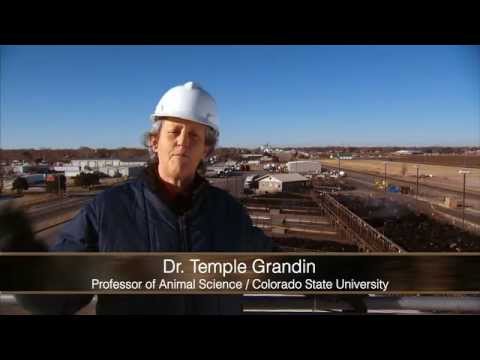
Dr. Grandin has become a prominent author and speaker on the subject of autism because "I have read enough to know that there are still many parents, and yes, professionals too, who believe that 'once autistic, always autistic.' This dictum has meant sad and sorry lives for many children diagnosed, as I was in early life, as autistic. To these people, it is incomprehensible that the characteristics of autism can be modified and controlled. However, I feel strongly that I am living proof that they can" (from Emergence: Labeled Autistic).
Temple
Grandin, Ph.D., is now the most accomplished and well-known adult with autism
in the world. Her fascinating life, with all its challenges and successes has
been brought to the screen. She has been featured on NPR (National Public
Radio), major television programs, such as the BBC special "The Woman Who
Thinks Like a Cow", ABC's Primetime Live, The Today Show, Larry King Live,
48 Hours and 20/20, and has been written about in many national publications,
such as Time magazine, People magazine, Forbes, U.S. News and World Report, and
New York Times.. Among numerous other recognitions by media, Bravo Cable did a
half-hour show on her life, and she was featured in the best-selling book,
Anthropologist from Mars.
Dr. Grandin
presently works as a Professor of Animal Science at Colorado State University.
She also speaks around the world on both autism and cattle handling. At every
Future Horizons conference on autism, the audience rates her presentation as
10+.
"I was
lucky. Very, very, very lucky," said Grandin, who's widely described as
the most well-known person with autism in the world. With appearances on NBC's
"Today" show and "Larry King Live," plus an Emmy-winning
2010 HBO docudrama based on her life, there's no arguing she's become something
of a pop-culture icon.
Source: http://www.templegrandin.com/
Subscribe to:
Comments (Atom)